
First voyage?
Take 10% off your first order with code MOTHERSHIP10.
First voyage?
Take 10% off your first order with code MOTHERSHIP10.

Original art. Festival ready.
✍️ Design Stories
Every pattern begins as an original piece of art. A dream, an old pattern reborn, a doorway.
✍️ Design Stories
Every pattern begins as an original piece of art. A dream, an old pattern reborn, a doorway.

Wear the story.
Free shipping on orders over $100 • Mothership Markers ship free in the US

June 16, 2026 12 min read
A blacklight party is simple in theory and easy to get wrong in practice. The whole effect comes down to one thing most people underestimate: you need enough real ultraviolet light in a dark enough room, and then you need to fill that room with things that react to it. Get those two right and an ordinary living room turns into something that looks like the inside of a dream. Get them wrong and you have a dim party with a couple of purple bulbs and everyone wondering why nothing is glowing.
I make UV-reactive products for a living and I have thrown, lit, and painted a lot of these nights. So this is the honest, practical version: how the light actually works, what glows and what does not, what to wear, how to do the makeup, the games and the food and drinks, and the mistakes I watch hosts make every single time. By the end you will be able to throw a glow party that genuinely lights up, whether it is an adults-only rave in your basement, a kid's birthday, or a Halloween night nobody forgets.
Let us build it from the light up.
Before you buy a single decoration, understand the physics, because this is where most glow parties live or die.
A "blacklight" is a lamp that puts out mostly ultraviolet light, the kind your eyes cannot see directly. When that invisible UV hits certain materials, those materials absorb it and throw it back as visible color, which is why a white shirt or a splash of neon paint suddenly looks like it is lit from inside. That effect is called fluorescence, and it is the entire point of the party. If you want the deeper version of why things light up under UV, I wrote a whole piece on the science of why things glow under blacklight, but for throwing the party you only need the practical rule: more UV light, spread across the room, equals more glow.
The single biggest mistake is not enough light. One weak bulb in the corner will not cut it for anything bigger than a closet. For a normal room you want several UV sources spread around so the glow is even and nobody is standing in a dead zone. Think in terms of coverage, not one hero lamp. LED UV bar fixtures, the kind that wash a wall in light, are the best value for a real room, because they throw a lot of UV across a wide area and run cool. Screw-in UV LED bulbs in lamps you already own are a cheap way to add fill light in the corners. For a big space, a couple of UV "cannon" or flood fixtures on stands will do what a handful of bulbs cannot.
UV light only reads when the room is dark. Any competing white light, a lamp, an overhead fixture, a bright kitchen spilling in through a doorway, washes out the glow and ruins the effect. So the second half of the setup is killing every ordinary light source. Turn off the overheads, cover or unplug glowing electronics, and block the windows if it is still light outside or there is a streetlight nearby. Blackout curtains, dark sheets, or even taped-up garbage bags over the windows make a shocking difference. The darker the room, the harder everything glows. A pitch-black room with moderate UV beats a dim room with strong UV every time.
Not everything sold as a blacklight is created equal. The good fixtures put out genuine longwave UV (you will see UV-A or 365 to 400 nanometers on the listing) and make neons absolutely pop. The cheapest novelty bulbs mostly just glow purple themselves and barely excite anything in the room, which is why people buy one, screw it in, and feel let down. Spend on the light. It is the one thing you cannot fake, and it is what every other dollar at the party depends on.
Once the light is right, the fun is figuring out what lights up. Some of it you buy, and a surprising amount you already own.
A lot of everyday stuff fluoresces under UV, and leaning on it keeps the budget sane. White anything glows hard, so white tablecloths, white balloons, white paper, and white string all read like they are lit. Fluorescent and neon colors, especially highlighter yellow, neon green, orange, and pink, are the strongest glowers you can buy in plain craft form. Plain printer paper, a lot of white plastics, and tonic water (more on that under drinks) all light up. Even teeth and the whites of eyes glow, which is why everyone's smile looks slightly unhinged and delightful under a blacklight.
A cheap, high-impact trick: highlighter markers. The ink in standard highlighters is fluorescent, so anything you write or draw with a yellow or green highlighter glows under UV. Hand them out, cover a white tablecloth or a roll of butcher paper, and let people draw. It is free decoration that the guests make themselves.
To push it further, the reliable purchases are neon and UV-reactive party supplies. Neon balloons and streamers, blacklight-reactive tablecloths and banners, glow tape to outline doorways and steps and the edges of tables so nobody trips in the dark, and fluorescent poster board for signs and cutouts. Neon string or fishing line strung across the room basically disappears in the dark and then glows like laser beams under UV, which looks far more expensive than it is. Glow sticks and LED string lights add their own light rather than reacting to the UV, so they fill in color and give the room depth.
If you like making things, UV opens up cheap, dramatic DIY. Splatter-paint a banner or a sheet with fluorescent washable paint for an instant backdrop. Cut neon poster board into stars, planets, or whatever your theme is and hang them on that invisible neon fishing line so they appear to float. Write glowing messages and arrows on the walls with removable highlighter or UV-reactive markers on paper taped up around the room. Fill clear balloons or jars with glow sticks. The whole aesthetic rewards a little effort, because the darkness hides every rough edge and the glow flatters everything.
Outfits are half the fun, and the dress code basically writes itself: wear things that glow.
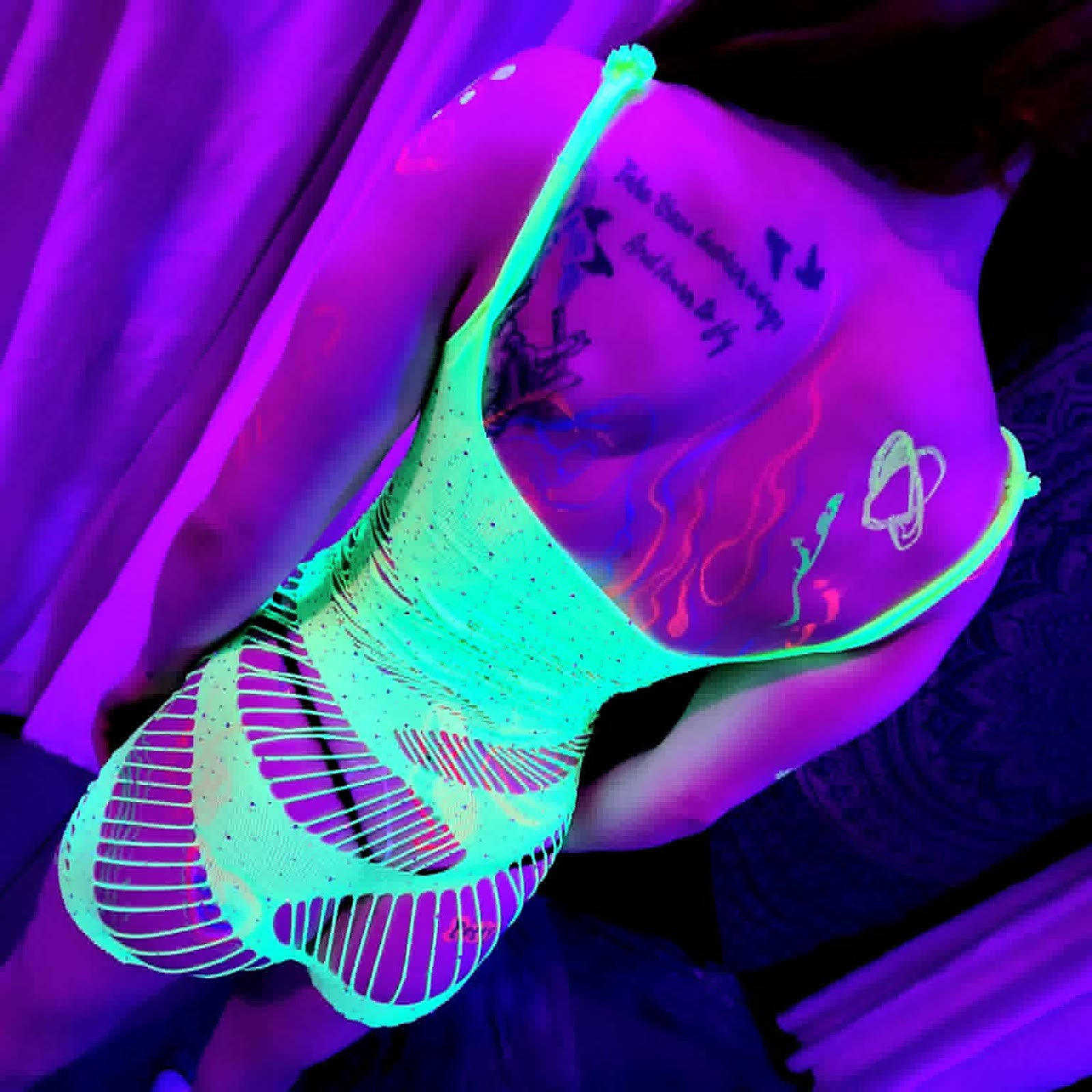
White and neon are the heroes. A plain white tee or white dress lights up like a beacon, so white is the easiest "I tried" outfit there is. Neon colors, the brighter and more fluorescent the better, glow almost as hard. Tell your guests this in the invite, because a room full of glowing outfits is most of the atmosphere, and one person in a dark band shirt will just vanish. Beyond the basics, anything that fluoresces is fair game: neon accessories, glow jewelry, white sneakers, fluorescent face and body paint, and UV-reactive hair gel or temporary color.
If you want the full breakdown of building festival and glow outfits that actually photograph well, I put it all in the what to wear to a festival guide, and it carries straight over to a glow party. The short version: pick a base that glows (white or neon), add a few high-contrast accents, and let the makeup and accessories do the loud talking. You do not need a costume. You need a few glowing pieces and the confidence to walk into a dark room looking like a lightning bolt.
This is where a good glow party becomes a great one, because nothing reads under UV like clean fluorescent linework on skin.
The basic idea is simple: UV-reactive face and body paint glows brilliantly under the blacklight while ordinary makeup mostly goes dark. So you want products actually formulated to be UV-reactive, applied as crisp lines and shapes rather than big filled-in areas, because lines read as light and fills read as flat. Think glowing cheekbone stripes, constellation dots across the nose, a third-eye mark on the forehead, body lines tracing collarbones and arms. Keep it skin-safe and water-based, do a quick patch test if anyone has sensitive skin, and only ever use cosmetic-grade product on faces, never craft or poster paint.
I am not going to re-teach the whole craft here, because I already wrote the complete version. For application, colors, how to make it last, and how to take it off without wrecking your skin, send your guests (and yourself) to the complete blacklight makeup guide. Set up a small "glow station" at the party with a mirror, a few UV products, and some wipes, and let people paint each other. It becomes the most popular corner of the room every time.
A glow party can coast on the look alone, but a few activities turn it into an actual event people talk about.
For all ages, glow-in-the-dark versions of classic games land well. Glow bowling with glow sticks taped to water bottles and a glowing ball, glow ring toss with neon bands and a glowing stake, and a glowing beanbag or cornhole setup all work because the UV makes the targets pop. Hide-the-glow-object scavenger hunts are great for kids: hide small glowing items around the dark space and let them hunt with the lights down. A "freeze dance" under the blacklight is chaos in the best way, because everyone is glowing and mid-motion when the music stops.
For adults, lean into the dancefloor. The truth is most adult glow parties are just a great house party with better lighting, so the "activity" is the music and the room. A glow-paint station, a neon photo corner with a UV-lit backdrop (your phone camera captures the glow better than you would expect if you turn the flash off), and maybe a glow-stick toss or a best-outfit vote are plenty. Body-paint tic-tac-toe and drawing glowing temporary tattoos on each other are low-effort and weirdly addictive. The room does most of the work. Your job as host is to light it well and get people glowing early.
Yes, you can make the food and drinks glow too, and it is a genuine showstopper if you know the one real trick.
The single most reliable glowing drink is anything made with tonic water. Tonic contains quinine, which fluoresces an eerie bright blue under UV light, completely naturally and completely safely. A gin and tonic, or just tonic over ice with a splash of color, will glow blue in your hand under the blacklight with zero special effort. Freeze tonic water into ice cubes and drop them in any clear drink for floating glowing cubes. This is the one food-and-drink effect that is real, easy, and safe, so build your bar around it.
Beyond tonic, you can fake or enhance the glow with color. Drinks made bright with neon-colored mixers, sodas, or edible neon food coloring will pop under UV, especially the yellows and greens. Light-colored and bright foods photograph as glowing: think neon frosting on cupcakes, brightly iced cookies, yellow and orange fruit, and white or pale snacks on a dark table. For a kids' party, glowing jello made with tonic water (small amounts, and check that everyone is fine with quinine) or simply very brightly colored treats do the job.
One safety line worth saying plainly: do not put glow-stick liquid, craft glow powder, or any non-food glow product in or near anything anyone eats or drinks. The only thing you should be ingesting is normal food and drink that happens to fluoresce, like tonic water, or food made bright with edible coloring. Decorate the table with the glowing non-edibles, and keep the actual food and drink in the safe, edible lane.
The same core setup flexes across very different events. Here is how to tune it.
For adults, this is essentially a rave you host. Heavier on the UV lighting and the dancefloor, lighter on organized games. Push the outfit and body-paint angle hard, build the bar around tonic-water drinks, and treat the music and lighting as the main event. A dark basement, garage, or backyard after sundown is ideal. This is the version where the glow makeup and a real sound system matter most.
For kids, dial up the activities and dial down the intensity. Glow games, a scavenger hunt, glow-stick party favors, and washable UV face paint with parent supervision make it a hit. Keep the room dark but safe (glow-tape the edges and steps), use plenty of bought glow sticks and bracelets so every kid is lit up, and keep the food in the bright-but-normal lane. Neon and white clothing in the invite turns the whole group into the decoration.
Halloween and UV are made for each other, because a blacklight lets a costume hide a second layer that only appears in the dark. A look that reads as one thing in daylight can reveal glowing markings, wounds, or patterns the second the UV comes up. Glowing "ghost" effects with white fabric, UV-reactive fake blood and face paint, and a fog machine catching the UV beams in the air all push the spooky factor. It is the one night of the year where a fully committed blacklight room feels completely expected, so go all in.
Let me save you from the errors I see at almost every glow party that underwhelms.
Avoid those and you are already throwing a better glow party than most people ever pull off.
If you want the easiest way to get everyone at the party glowing without a mess, this is the part where I tell you what I make. I build UV-reactive markers precisely because the hardest part of a glow party, at the makeup station and on the dancefloor, is getting clean glowing lines on skin without smearing paint everywhere. A marker draws sharp, deliberate lines that read as actual light under UV, it is water-based and made for skin, and it comes off with its own gentle remover when the night is over. Hand a few around at the party and people draw on each other for an hour. That is the whole pitch. Any good UV product works, but a marker is the cleanest way to turn a room full of guests into a room full of glowing artwork.
Two things together: enough real UV light, and a dark enough room. Use several genuine UV fixtures (UV-A LED bars or floods, not cheap novelty purple bulbs) spread around the space, then kill every other light source and block the windows. Then fill the room with things that fluoresce: white and neon decorations, glowing outfits, UV body paint, and tonic-water drinks.
White materials, fluorescent and neon colors (especially highlighter yellow, green, orange, and pink), plain white paper, highlighter ink, many white plastics, teeth and the whites of eyes, UV-reactive paint and makeup, and tonic water (which glows blue thanks to quinine). Most ordinary dark colors do not glow, which is why white and neon are the rule for outfits and decor.
Wear white or bright neon, because both light up hard under UV. A plain white tee or dress is the easiest glowing outfit. Add neon accessories, glow jewelry, white sneakers, and UV-reactive face and body paint. Tell your guests the dress code in the invite so the whole room glows instead of just a few people.
Anything made with tonic water glows blue, because the quinine in tonic fluoresces under UV naturally and safely. A gin and tonic, or tonic over ice, will glow in your hand. You can also freeze tonic into glowing ice cubes. Other drinks can be made to pop with bright neon mixers or edible neon food coloring. Never use glow-stick liquid or non-food glow products in anything you drink.
More than one. A single bulb only lights a tiny area. For a normal room, use several UV sources spread around for even coverage: UV LED bar fixtures to wash the walls plus a few UV LED bulbs in existing lamps for the corners. For a large space, add a couple of UV flood or cannon fixtures on stands. Coverage matters more than one powerful lamp in a corner.
Always keep exploring. The dark is not dangerous. It is waiting.