
First voyage?
Take 10% off your first order with code MOTHERSHIP10.
First voyage?
Take 10% off your first order with code MOTHERSHIP10.

Original art. Festival ready.
✍️ Design Stories
Every pattern begins as an original piece of art. A dream, an old pattern reborn, a doorway.
✍️ Design Stories
Every pattern begins as an original piece of art. A dream, an old pattern reborn, a doorway.

Wear the story.
Free shipping on orders over $100 • Mothership Markers ship free in the US

June 16, 2026 18 min read
I make UV-reactive body paint for a living, and I have painted a lot of faces in a lot of dark rooms. So I want to give you the honest version of how blacklight makeup actually works, what to buy, how to apply it so it glows hard and lasts, and the mistakes I see beginners make every single weekend. The goal here is for you to walk into your next dark room knowing exactly what you are doing. If my own product comes up, it is because it is what I reach for, but everything in this guide works with any good UV makeup you choose.
Let us get into it.
Before you spend a dollar, understand what is happening, because it will save you from buying the wrong thing.
Some makeup glows under blacklight, and a lot of it does not. The glow you are chasing is fluorescence: certain pigments absorb the invisible ultraviolet light coming off a blacklight and instantly throw it back as visible color, so the makeup appears to light up on its own in a dark room. It is not magic and it is not the makeup producing light by itself. It is the pigment translating UV you cannot see into color you can.
The catch is that only specific pigments do this. A product has to be made with UV-reactive, fluorescent pigments to glow under a blacklight. Most everyday makeup is built with ordinary pigments that look great in normal light and simply go dark or dull when the UV hits them. So the honest answer is that makeup glows under blacklight only when it was specifically formulated to, which is exactly why dedicated blacklight makeup exists.
The thing doing the work is the fluorescent pigment. These are special colorants engineered to absorb ultraviolet wavelengths and re-emit them as bright visible light, which is what gives UV makeup that electric, almost lit-from-within look in the dark.
A few practical notes that matter more than the chemistry. The brightest glow usually comes from products built around these fluorescent pigments as the main event, not as an afterthought. White and the neon brights, green, pink, orange, blue, yellow, tend to pop the hardest under UV because of how those pigments respond. And for anything going on your skin, what matters as much as the glow is the base the pigment is suspended in: a clean, skin-safe, water-based formula is what you want, not an industrial paint that happens to fluoresce. The pigment makes it glow. The base makes it safe to wear on your face.
This is the single most common mix-up, and getting it right will stop you from buying the wrong product. There are two completely different effects people lump together.
Blacklight makeup is fluorescent. It only glows while a UV blacklight is shining on it. Kill the blacklight and the glow stops instantly. This is what you want for raves, festivals, and any venue with blacklights, because that is where it comes alive.
Glow-in-the-dark makeup is phosphorescent. It absorbs regular light, stores it, and then slowly releases it as a faint glow in total darkness for a little while, with no blacklight needed. Think of those old glow stars on a ceiling. The effect is dimmer, fades over minutes, and works in the dark on its own.
So the difference is simple and crucial: fluorescent blacklight makeup needs a UV light and glows brilliantly the whole time it is lit, while phosphorescent glow-in-the-dark makeup charges up and then fades on its own in the dark. For a blacklight party or a festival with UV lighting, you want the fluorescent kind. If a product just says glow in the dark, double check which effect it actually is before you buy.
You will also see LED looks floating around, and they are a different thing entirely. LED makeup is not pigment at all. It is tiny battery-powered lights physically stuck to the skin, so it produces actual light on its own with no blacklight required. It can look incredible in photos, but it is essentially wearable electronics: more expensive, more fragile, harder to apply, and limited to where you can attach little lights.
For most people in most rooms, fluorescent blacklight makeup wins on practicality by a mile. It is paint you can draw anywhere on your face and body, it costs a fraction of an LED setup, and in a venue that already has blacklights it glows just as vividly with none of the hassle. LEDs are a fun novelty for a specific look. Blacklight makeup is the versatile, affordable, do-anything option.
Before you buy anything new, the obvious question is whether your existing kit will do the job. Mostly, no, and here is the real answer.
You can wear it, but most of it will not glow, and some of it does something you might not expect. Standard makeup is made with ordinary pigments, so under a blacklight it generally just goes flat and dark instead of lighting up. You will not get the neon effect you are after from your everyday eyeshadow or lipstick.
There is one quirk worth knowing. A handful of regular products contain ingredients that happen to fluoresce, so some whites and a few bright shades can glow a little by accident, and anything with optical brighteners can react. But this is unreliable and you cannot count on it for a planned look. If you want a guaranteed, vivid glow, you need makeup actually formulated to be UV-reactive. Hoping your regular kit cooperates is how people end up looking dull in the one room they wanted to shine in.
Yes, and layering the two is actually one of my favorite techniques. Your regular makeup builds the base of the look, the foundation, the structure, the everyday version of your face, and the blacklight makeup goes on top as the part that ignites when the UV comes up. The result is an outfit that reads as a normal, polished look in daylight and transforms into something electric the moment you walk under the blacklights.
A couple of pointers when you combine them. Put your regular makeup down first and let it set, then add the UV-reactive pieces as accents and lines on top, because the glow reads best as crisp shapes rather than mixed into everything. And keep the UV product as the star where you want the light to land, your cheekbones, your liner, your body lines, so the transformation has a clear focal point. Layering is how you get a look that works in both worlds instead of only one.
This is where people waste money, so spend a minute here.
Safety is the first filter, before color, before price, before anything. The single most important rule: only use products specifically labeled as cosmetic grade and made for face and body. This is not optional. Craft paints, poster paints, and novelty glow products can contain solvents and industrial dyes that were approved for paper and plastic and never meant to touch skin, and people get into trouble every year by using them on their faces because they happened to glow.
When you are evaluating a product, look for a few plain signals: it states face and body use right on the packaging, it is water based so it washes off without harsh solvents, it has an ingredient list you can actually find, and the maker offers a removal method. A glow product with no published ingredients and no clear skin-safe labeling is a no, no matter how bright it looks. Brands that planned for your skin tend to say so clearly.
For sensitive skin, the move is to choose a clean, water-based, cosmetic-grade formula and then patch test before the event. Put a small amount on the inside of your wrist a few hours ahead and make sure your skin is happy with it. That advice does not change just because a product glows, and any cosmetic can bother somebody, so the patch test is cheap insurance whether your skin is reactive or not. People with sensitive skin generally do best with simple, water-based products and should be wary of anything heavy, fragranced, or vague about its ingredients.
The eye area needs extra care. The skin around your eyes is delicate and your eyes themselves are sensitive, so use products rated as safe for the eye area, keep paint off the waterline and out of the eye itself, and apply gently. If you wear contacts, be especially careful. If anything stings, waters, or irritates, take it off. UV liner and shadow on the lids and brows can look unbelievable, but treat the eye zone as the place to be conservative, not adventurous.
Good news here: UV-reactive makeup is more forgiving across skin tones than regular makeup, because the glow comes from the pigment reacting to the light rather than from how the color sits against your complexion. In a dark room, the blacklight is doing the lighting, so the neon pops on nearly everyone.
That said, a few tips help you get the most out of it. On deeper skin tones, the bright neons and especially white tend to glow with stunning contrast, so lean into them. On fairer skin, you have room to play with the full range, including the colors that sit closer to your natural tone in daylight. And across all skin tones, the trick is contrast: pick the UV colors that stand out most against your skin in the dark, test a couple of shades on yourself, and build around the ones that light up hardest on you. Your skin tone changes which colors sing, not whether the makeup works.
UV-reactive makeup comes in the same range of formats as regular makeup, and each has a job.
If you are buying one thing, I would steer you toward whichever format lets you make clean lines, because lines are what glow hardest under UV. This is exactly why I build what I build in a marker format: the precision of a marker tip is what turns a vague smudge of glow into sharp, deliberate linework that actually reads in the dark. Fills look flat under blacklight. Lines look like light. Whatever product type you choose, prioritize the one that lets you draw.
You can find blacklight makeup at costume shops, specialty beauty retailers, festival and rave stores, and online from the brands that actually specialize in it. I would point you toward dedicated UV and festival makeup makers over generic seasonal costume bins, because the specialists care about the formula and the glow in a way the novelty stuff does not.
On the budget versus professional question, here is my honest take. Cheap blacklight makeup absolutely exists and it can work fine for a one-off costume or a casual night. But the difference you pay for in a quality product is real: a better, safer base on your skin, a brighter and more reliable glow, colors that do not turn patchy, and removal that does not fight you. If you are going to wear it once for Halloween, a budget option is reasonable. If you are going to wear it through a festival weekend or you have sensitive skin, the better product earns its price in comfort, performance, and not ruining your night. Spend where it touches your skin for hours. Save where it does not matter.
This is the step almost everyone skips and then regrets. A product can look one way in the tube or on a daylight swatch and completely different under actual UV. Whenever you can, see it glow before you commit.
In a store, ask whether they have a blacklight to test under, because reputable festival and costume shops often do. Online, look for brands that show real swatches photographed under blacklight rather than just the daytime color, so you can see how each shade actually performs in the dark. And once you have a product, test it on yourself under a blacklight at home before the event, both to confirm the glow and to patch test your skin. A few minutes of testing beforehand is the difference between confident and surprised.
Now the fun part. Here is how to actually do it, starting simple.
If you have never done this, do not start with a full face. Start with accents and build confidence. Here is a beginner-friendly sequence that looks intentional and is nearly impossible to mess up.
That is a complete, striking look built entirely from simple shapes. A starter set or small palette of a few core neon shades is plenty to do all of this, and you do not need a huge collection to get started. Master these accents first, then graduate to a geometric mask or a full split-face look once your hand is steady.
The difference between a glow that pops and one that looks muddy is almost all in the application. The rules that matter:
Maximum glow is not about piling on more product. It is about clean, deliberate, high-contrast shapes that let the pigment do its job.
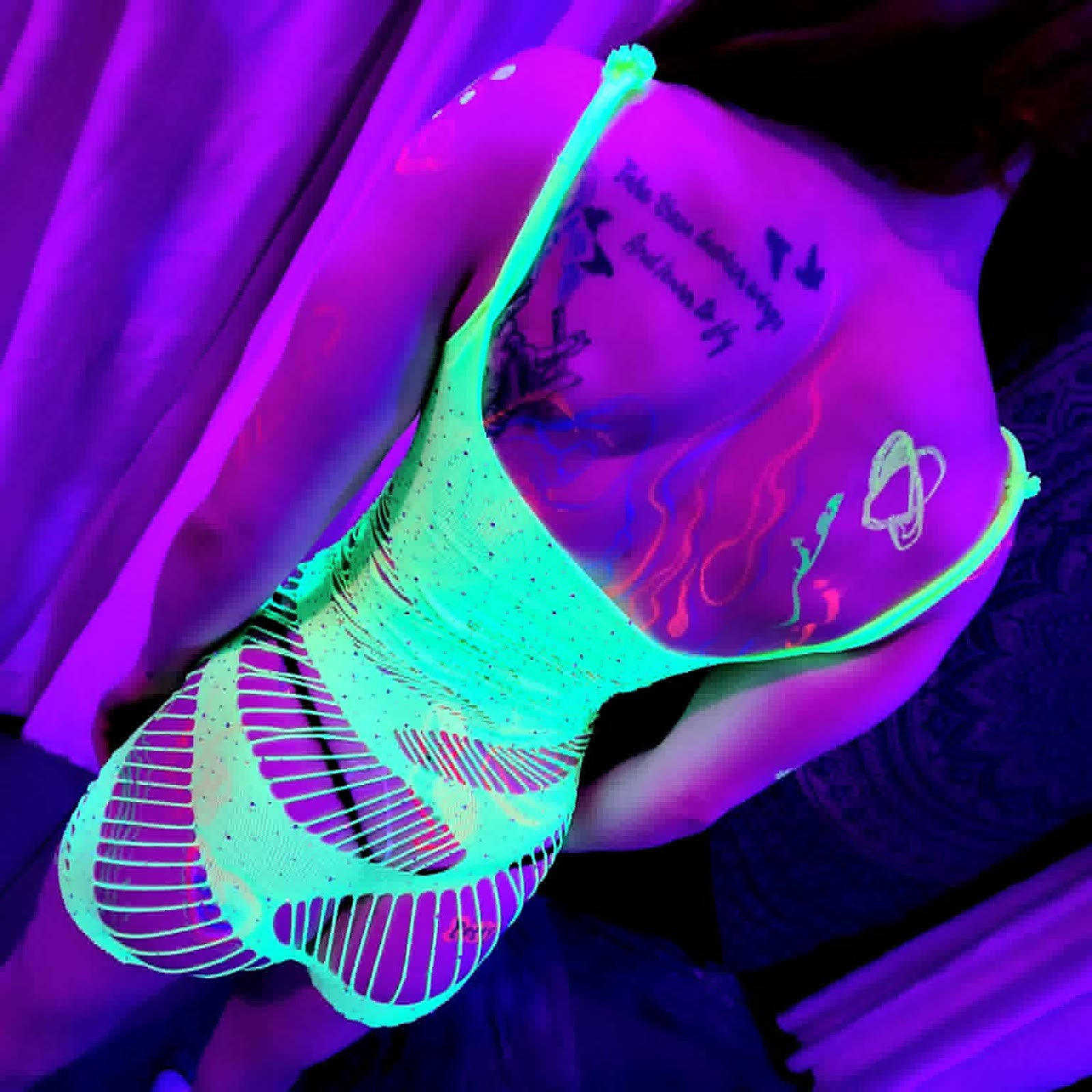
Once you are comfortable on the face, the whole body opens up, and body art is where UV makeup gets genuinely jaw-dropping. The same principles scale up: clean lines, negative space, symmetry, thin layers. Trace the natural lines of the body, the collarbones, the shoulders, the spine, the backs of the hands, the forearms, so your whole silhouette glows as you move.
A few body-specific tips. Keep your boldest work on lower-friction areas like collarbones and the backs of hands, because spots that rub against clothing or other people fade faster. Linework along the arms echoes the light trails you see on a dancefloor and looks incredible in motion. And for big designs, a marker or fine applicator gives you the control that a brush or sponge cannot, which is again why I am partial to the marker format for body art: you are drawing, not painting, and drawing is what reads.
If you want a concrete starting point, here is a ladder of designs you can climb as your hand gets steadier. They are ordered easiest to boldest, and the rule from the application section holds the whole way up: clean lines, negative space, and symmetry read as light, while big filled areas read as flat.
Start at the top of the ladder, not the bottom. An under-eye accent done well beats an ambitious full-face look done in a hurry, and the simple designs are the ones that survive a sweaty, crowded room.
The applications go well beyond raves, and the same products carry across all of them.
For parties and blacklight events, think bold accents and neon linework that transform a normal look the instant the UV comes on. For Halloween, UV makeup is a secret weapon, because a costume that looks complete in daylight can hide a glowing design that only reveals itself under blacklight, which is a genuinely unforgettable effect for the right party. For cosplay, UV-reactive makeup lets you build characters with glowing markings, energy effects, and otherworldly features that come alive in a dark room or under a blacklight at a convention.
As for what is popular right now, the through-line in current looks is clean, graphic, glowing linework: sharp geometric shapes, symmetrical face designs, delicate constellation and dot work, and full-body line tracing rather than heavy all-over color. The trend has moved toward precise and deliberate over messy and maximal, which is good news, because precise linework is also what glows best. Whatever look you are chasing, the same skill, clean lines, carries it.
A look is only as good as how long it survives. Here is how to make it go the distance.
Longevity starts before you ever apply color. Begin with clean, dry, oil-free skin, because oil is the enemy of staying power. Build in thin layers and let each set rather than rushing one thick coat. Apply as late as you reasonably can before the event rather than hours ahead. And once it is on and dry, stop touching it, because the fastest way to ruin UV makeup is to keep fiddling with it.
A primer can genuinely help here. A makeup primer creates a smooth, slightly tacky base that gives the product something to grip, which can meaningfully extend how long your look lasts, especially on areas prone to sweating or rubbing. If you have a primer you already like, use it under your UV makeup. For a hot, crowded room, a water-based, sweat-resistant formula is what you want, because it is built to set against sweat while still coming off cleanly later. Carry your liner or a small touch-up piece too, since a quick refresh on one fading line resets the entire look in seconds.
Knowing the enemies helps you plan around them. The main things that break a look down over a night are sweat, friction, and oil. Sweat from dancing in a packed room lifts product, friction from clothing and contact rubs it away, and your skin's natural oils loosen its grip from underneath. Touching your face, wiping, and general wear do the rest.
You cannot eliminate any of these at a real event, but you can manage them. Keep your boldest designs on lower-friction high points, prep with clean oil-free skin, use a sweat-resistant formula and a primer, and accept that the inner arm in a mosh will not last like a cheekbone accent will. Place your most important work where the night will not rub it off, and carry a touch-up for the rest.
It matters more than people realize, and it comes down to the light. Indoors, venues control the lighting and usually run dedicated blacklights, so your UV makeup glows exactly as intended in a dark, UV-rich room. This is the ideal environment and where the effect is strongest.
Outdoors is trickier, because daylight kills the effect entirely. In sunlight your UV makeup mostly just looks like its daytime color, since you need darkness and a UV source for the glow to show. At an outdoor festival, your glowing look comes alive after dark when the stage blacklights and UV lighting take over, not during the afternoon. So plan around it: for a daytime outdoor event, choose colors that also look good in normal light, since you will be wearing the daytime version for hours before the glow ever arrives. For an indoor blacklight venue, you can go all in on the glow because the room is built for it. Same makeup, very different timing depending on where you are.
The night ends, and how you take it off matters as much as how you put it on.
Good skin-safe UV makeup should come off easily, and if it does not, that tells you something about what it was made of. For a water-based product, warm water and a gentle soap or cleanser, worked in circles, removes most of it. For stubborn pigment around the hairline, the knuckles, and the creases, a regular makeup remover or a dedicated remover finishes the job without scrubbing.
The things to avoid are just as important as what to use. Skip harsh alcohol and abrasive scrubbing, because your skin just spent a whole night working and does not need to be stripped raw on top of it. Be especially gentle around the eyes, using a proper eye-makeup remover there. Whatever you remove with, do it kindly: soften the product, wipe gently, repeat if needed, and moisturize after. If a UV product refuses to come off with soap, water, and gentle remover, that is the formula telling you it was never really made for skin, which is a reason to choose a cleaner product next time.
Treat UV makeup like any quality cosmetic and it will last. Store it in a cool, dry place out of direct sunlight, because heat and sun degrade both the formula and the pigment over time. Keep the caps and lids closed tight so products do not dry out, and keep water out of anything that is not meant to get wet between uses.
On shelf life, blacklight makeup does not last forever. Like all cosmetics it has a usable lifespan, and you should retire a product when it changes in smell, texture, or color, when it dries out, or when the glow noticeably weakens. Check for any period-after-opening guidance on the packaging and follow it. Stored well and kept clean, a good product will serve you across many events, but do not hang onto something that has clearly turned, especially anything going near your eyes. Fresh, clean product is part of keeping your skin happy.
Let me save you from the errors I watch people make over and over.
Avoid those nine and you are already ahead of most people walking into the dark.
Here is the thing I most want you to take from all of this. Blacklight makeup is not complicated. It comes down to a few true rules: buy a cosmetic-grade, water-based, skin-safe product that is actually formulated to be UV-reactive, draw clean lines instead of filling, start with clean dry skin, build thin layers, and take it off gently. Get those right and you will glow brilliantly with whatever quality product you choose.
I make UV-reactive markers because I wanted the cleanest possible lines on skin, in a water-based, sweat-resistant, made-for-skin format that comes off with its own gentle remover when the sun comes up. That is my answer to everything above. But the rules in this guide are bigger than any one product, and they will serve you no matter what is in your kit. The dark is not dangerous. It is just waiting for you to draw on it.
Always keep exploring, and have an incredible night.
Only makeup made with UV-reactive, fluorescent pigments glows under a blacklight. Those pigments absorb invisible ultraviolet light and throw it back as visible color, so the makeup looks lit from within. Most ordinary makeup uses standard pigments that simply go dark or dull under UV, which is why dedicated blacklight makeup exists.
Blacklight makeup is fluorescent: it only glows while a UV light is shining on it, and the glow stops the instant the light is off. Glow-in-the-dark makeup is phosphorescent: it charges up under normal light, then releases a faint glow in total darkness with no blacklight needed. For raves, festivals, and blacklight parties you want the fluorescent kind.
It is safe if you use a product specifically labeled cosmetic-grade and made for face and body. Choose a clean, water-based formula, patch test before the event, keep it off the waterline and out of the eyes, and never use craft or poster paint on skin. A product with no published ingredients and no skin-safe labeling is a no, no matter how bright it looks.
Start with clean, dry, oil-free skin, build in thin layers letting each set, and apply as late as you reasonably can before the event. A primer helps it grip, a water-based sweat-resistant formula holds up in a hot room, and once it is on and dry, stop touching it. Carry a touch-up piece to refresh one fading line.
Skin-safe, water-based UV makeup comes off with warm water and a gentle soap or cleanser worked in circles, with a regular makeup remover for stubborn spots around the hairline and knuckles. Avoid harsh alcohol and abrasive scrubbing, and be gentle around the eyes. If a product will not come off with soap, water, and gentle remover, it was never really made for skin.