Shop
Designs

Free Shipping on Every Order USA

June 07, 2026 7 min read

Short version: things glow under black light because certain molecules catch invisible ultraviolet light, hold it for a few billionths of a second, and spit it back out as a color you can actually see. It is not paint catching the light. It is matter turning one kind of light into another, live, on your skin.

Long version has a Victorian nerd staring at gin, a desert crawling with glowing scorpions, a platypus nobody checked for seventy years, and the reason a festival crowd at 1am looks like a galaxy that figured out how to dance. Stick around.

What fluorescence actually is

Light is energy moving in waves, and every color is a frequency. Violet rides in tight and hot. Red rolls in long and lazy. Just past violet, past anything your eyes can clock, sits ultraviolet: light carrying too much energy for you to see it at all.

A fluorescent molecule is basically a tuning fork for that invisible light. UV hits it, its electrons grab the energy and jump up a level, and then, because nothing that excited stays excited, they crash back down and dump the energy out as brand new light. A little gets lost in the fall, so what comes out is always a calmer, more visible color than what went in. Scientists call that the Stokes shift. You will call it the exact moment invisible nothing becomes screaming green.

That is the whole magic trick. A glowing surface under black light is not bouncing the room's brightness back at you. It is building visible light from scratch, which is why it looks like it is burning from the inside while everything around it stays pitch dark. Nothing is stored, nothing is used up. The molecule just translates, forever, as long as the UV keeps coming.

Glow under black light vs. glow in the dark

People mix these up constantly. They are cousins, not twins.

Fluorescence translates light in real time. Black light on, glow on. Black light off, glow gone. No memory, no delay.

Phosphorescence is the slow cousin. It swallows energy and leaks it back out for minutes or hours. That is your glow-in-the-dark stars, still wheezing green at 3am on light they ate at sunset.

Bioluminescence is the show-off cousin that makes its own light from pure chemistry. Fireflies, anglerfish, those electric blue waves at the beach. Glow sticks are the cheap knockoff of this one, which is why they die in your hand by sunrise.

Festival translation: glow sticks die, glow-in-the-dark fades, but fluorescence never runs out of battery. It burns at full power for as long as there is UV in the room. It is the only one that lasts the whole night.

How a black light works

A black light is just a lamp tuned to pump out UVA, the gentlest flavor of ultraviolet, while filtering nearly all the visible light back out. That moody purple glow you can see is the leftovers. The part doing the actual work is the part you can't see at all.

And it is older than you'd guess. Around 1903 an American physicist named Robert Wood cooked up a glass filter that blocked visible light but waved UV right through. Wood's glass gave the world its first real black light, and for decades it was strictly business: forensics teams reading invisible stains, geologists making rocks light up, art experts catching forgeries because old varnish snitches under UV. Deeply uncool. A tool.

Then the 1960s found it, and it never worked an honest day again.

What glows in nature (more than you think)

Point a black light at the world and it starts confessing.

Scorpions. Almost all of them glow eerie blue-green from a compound in their shell, and science still cannot fully agree on why. Best guess: the whole scorpion is a living UV detector that tells it when night has fallen hard enough to hunt. Desert researchers literally find them in the dark by sweeping the sand with UV lamps, and the sand glows back.

Tonic water. The quinine in it glows electric blue, and this humble drink is where the whole science started. In 1845 John Herschel noticed quinine shining at the surface of a glass; in 1852 George Stokes proved the glow was converted UV and named the effect fluorescence, after the mineral fluorite. Your gin and tonic is a 180-year-old physics experiment.

Chlorophyll. The stuff that makes plants green glows blood red under UV. Blend spinach into high-proof liquor, hit it with a black light, and watch your kitchen turn into a crime scene.

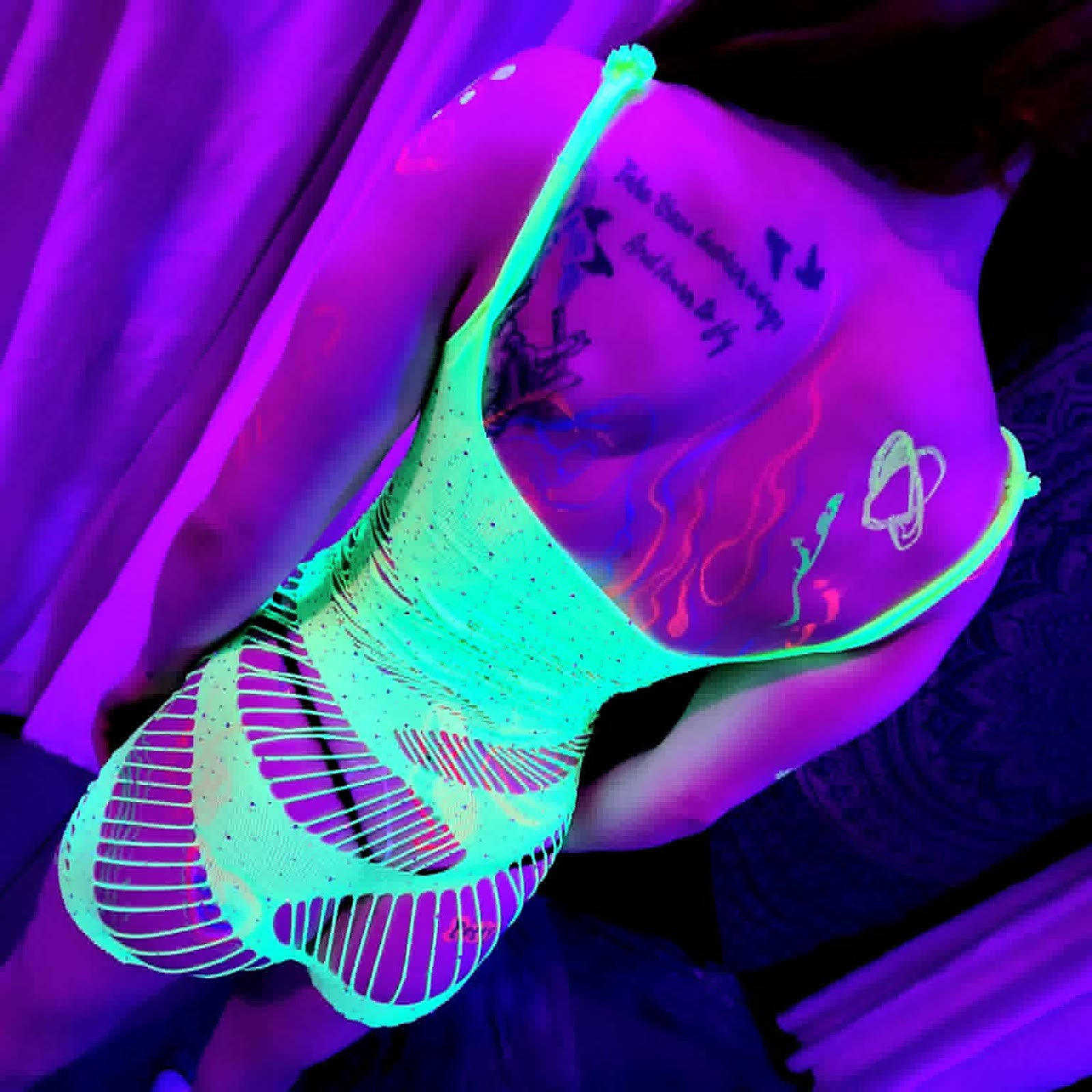
You. Teeth, fingernails, tears, and sweat all glow faintly. Human skin has a soft glow of its own under UV, which is part of why a crowd looks quietly alive before anyone even picks up paint.

Half the animal kingdom, apparently. Puffin beaks glow. Flying squirrels glow bubblegum pink. The platypus glows blue-green, a fact nobody bothered to check until 2020, which sent biologists sprinting to point UV lamps at every dusty museum drawer they owned. Nature has been throwing a rave since before we existed. We just finally found the right frequency to RSVP.

When glow became a party

The pigments came first. In the 1930s brothers Bob and Joe Switzer, one of them stuck recovering from a head injury in a dark basement, started messing with fluorescent compounds and accidentally invented daylight fluorescent paint, later trademarked Day-Glo. Their colors were so obnoxiously bright the military slapped them on signal panels in World War II. Safety orange owes them royalties. So does every highlighter you ever chewed.

Then came 1964, and a bus.

Ken Kesey and the Merry Pranksters painted an old school bus in swirling fluorescent color and drove it across America under a destination sign reading FURTHUR, a place that does not exist, because the going was the whole point. The parties that followed, the Acid Tests of 1965 and 66, were the first time black lights, fluorescent paint, painted skin, and live improvised music all crashed into the same room. Glowing handprints on the walls. Faces drawn in colors that did not exist ten minutes earlier. Every festival you will ever attend is a descendant of those nights, whether it knows it or not.

It spread fast. San Francisco poster artists weaponized fluorescent ink for the Fillmore. The 70s mailed it into a million teenage bedrooms as the blacklight poster. The 90s rave scene rediscovered the whole formula in warehouses, where UV paint turned strangers into landmarks you could navigate by. Sixty years later the instinct has not budged one inch: when the lights go down, people want to become the light.

Is black light safe for your skin?

Straight answer: party black lights emit UVA, the lowest-energy band of ultraviolet, the same stuff that drifts through your window on a boring Tuesday. A night under them is mild, well below what the sun hands you for free, and nowhere near UVB, the sunburn band, which black lights are not built to throw. Common sense still applies: don't stare into the bulb like it owes you money, and give your skin breaks.

What you put ON your skin matters more than the lamp. A lot of "glow" products are craft paint wearing a costume. Anything you draw on your body should be cosmetic grade, made for skin, and easy to wash off when the sun comes up. Read the label like you would for anything else going on your face.

Why glow belongs to the dark

Here is the part the textbook leaves out.

Fluorescence only exists in relationship. The pigment alone is chalky color in a bottle. The UV alone is invisible. The glow only happens when the two find each other, and only in the dark. It is a kind of light that refuses to perform in daylight, cannot be hoarded, and cannot be faked. You have to physically go where the darkness and the frequency are both waiting.

That is why glow has belonged to gathering places for sixty years, from the Acid Tests to whatever field you end up in next summer. Under black light a crowd stops being a crowd. The lines painted on a stranger's arms answer the lines on yours. Everyone turns into a constellation, lit up for each other on a channel the daytime world doesn't even broadcast.

We will be honest about why we wrote this. Mothership Markers exist for that exact moment: six UV-reactive, water-based colors made for skin, built by performers, with a remover for when the sun ruins everything. But the markers are just the instrument. The light, the physics, the sixty years of painted dancers, that part belongs to everybody. We just wanted the science told right.

The bus never stopped. The next dark room is waiting to see what you look like at 365 nanometers.

Always Keep Exploring.

Frequently Asked Questions

Why do things glow under black light? Fluorescent molecules absorb invisible ultraviolet light and instantly re-emit it as visible light. The glow is converted energy, not reflection, which is why fluorescent surfaces appear to shine from within while the room stays dark.

What is the difference between fluorescence and glow in the dark? Fluorescence glows only while UV light is hitting it and stops instantly when the light stops. Glow in the dark (phosphorescence) stores light energy and releases it slowly over minutes or hours.

What household things glow under black light? Tonic water (quinine glows blue), highlighter ink, white paper and white clothing (optical brighteners), teeth, fingernails, some vitamins, honey, and chlorophyll extracted from leafy greens, which glows red.

Do black lights damage skin? Party black lights emit UVA, the lowest energy form of UV, at levels well below sun exposure. A night under them is considered low risk. Avoid staring into any UV bulb at close range, and only use cosmetic grade products on skin.

Who invented the black light? Physicist Robert Wood developed the first practical UV-passing filter, known as Wood's glass, around 1903. Fluorescent paint followed in the 1930s when Bob and Joe Switzer invented Day-Glo pigments.

When did UV body paint become popular? Fluorescent paint on skin under black light first appeared at Ken Kesey's Acid Test parties in 1965 and 1966, spread through 1960s psychedelic poster art and 1970s blacklight posters, was revived by 1990s rave culture, and is now a festival staple.

Spaceman is the founder of The Mothership Landing and the face on the markers box. Event producer, DJ, performer, designer, and structural integrator: he works with bodies by day and lights them up by night. Two decades in the transformational music festival and rave scene, in the fields and warehouses these transmissions come from. Always Keep Exploring.