Shop
Designs

Free Shipping on Every Order USA

June 07, 2026 6 min read

A fractal is a shape built by repeating one simple rule at every scale, so its parts resemble the whole. Zoom into a fern and find smaller ferns; zoom into those and find smaller ones still. Nature uses fractals almost everywhere because repeating a simple rule is the cheapest way to build something complex.

That one idea, declared mathematically respectable only in 1975, turns out to describe coastlines, clouds, rivers, lightning, broccoli, and the wet machinery breathing inside your chest right now. It is also, we will admit, printed on some of our favorite fabric. Start small. It will repeat.

What is a fractal, in plain language?

Take a simple move. Repeat it on every piece of the result. Keep going.

A tree is the clearest demonstration: trunk splits into branches, branches split the same way into smaller branches, smaller branches into twigs. One rule, branch and repeat, applied with patience, and the result is a structure too complicated to draw by hand yet simple enough to grow from a seed. That property has a name, self-similarity: any piece, magnified, resembles the whole.

Classical geometry, the world of circles, triangles, and spheres, is the geometry of things humans make. Fractal geometry is the geometry of things that grow. The difference is honest: a circle is finished, but a fractal is a process caught mid-repeat, and so is every living thing you have ever met.

The man who named the roughness

Mathematicians had glimpsed these shapes for a century and filed them away as "monsters," curves too pathological to mean anything. The Polish-born mathematician Benoit Mandelbrot disagreed, and in 1975 he coined the word fractal, from the Latin fractus, broken. His 1982 book The Fractal Geometry of Nature opens with one of the great sentences in science: "Clouds are not spheres, mountains are not cones, coastlines are not circles, and bark is not smooth, nor does lightning travel in a straight line."

His most famous demonstration was a question that sounds like a joke: how long is the coastline of Britain? The answer, genuinely, is that it depends on your ruler. Measure with a hundred-kilometer ruler and you skip the bays; measure with a meter stick and the bays add length; measure around every pebble and the length keeps growing. Rough shapes do not have one length. They have a degree of roughness, a fractal dimension, a number describing how thoroughly a shape fills space. Mandelbrot's heresy was to say the monsters were not the exception. The smooth shapes were. Nature's default setting is rough, and the roughness has rules.

Where the fractals are hiding

Once you have the eye, the Earth stops hiding them.

The fern is self-similarity you can hold: each frond is a small copy of the whole leaf, each leaflet a copy of the frond. Romanesco broccoli takes it further, spiral cones made of spiral cones made of spiral cones, nature showing off in a vegetable.

Lightning branches because electricity feeling its way through air keeps making the same choice at every scale, and the river delta seen from altitude is the same drawing in slow motion, water choosing paths the way current does. Frost on a window, root systems under a tree, the cracks in dried mud: same family, same rule, branch and repeat.

You. Your lungs split from windpipe to air sacs through over twenty generations of branching, packing a gas-exchange surface roughly the size of a tennis court into a ribcage. Your blood vessels branch the same way to reach every cell with a fraction of the body's volume. Your neurons branch to touch thousands of neighbors. The pattern on our fabric is not a metaphor for nature. It is a diagram of the reader.

Why does nature build this way?

Because fractals solve the two problems every living thing faces: maximum reach, minimum material.

Branching is the most efficient way to deliver something everywhere, blood, water, air, electricity, and self-similar branching needs no blueprint, only one instruction executed repeatedly. A fern does not store the plan of a fern. It stores the rule, and the rule unfolds. Mandelbrot put it simply: nature builds by repeating a simple move with endless patience.

There is a deep economy in that. DNA cannot possibly specify the position of every airway in your lungs; there is not enough storage. It does not have to. It encodes the branching rule and lets geometry do the rest. Complexity is not designed, it is grown, which is why a single cell can become a body and a seed can become a canopy. The instructions are short. The patience is long.

Why do fractals calm the human brain?

This is the part that explains the staring.

Vision researchers measuring how people respond to fractal patterns find a consistent sweet spot: humans prefer, and relax in response to, fractals of moderate roughness, the same range that dominates natural scenes, savanna trees, cloud edges, coastlines. Eye-tracking and physiological studies report reduced stress markers when people view mid-range fractals, and one body of research found observers' stress measurably dropping within minutes. The leading explanation, fractal fluency, is the same machinery we described in our Flower of Life piece: the visual system evolved tuned to nature's statistics, processes them with minimal effort, and registers the ease as restoration. A walk in the woods is, among other things, your eyes being spoken to in their native language.

The strangest chapter: physicists analyzing Jackson Pollock's drip paintings found genuinely fractal structure in the layers of poured paint, with dimensions drifting upward over his career. Audiences who called the drips "natural" decades before the math existed were measuring something real with their nervous systems alone.

Color is borrowed

One more layer of the design's story, and it is the one we hold closest. No object owns its color. A leaf is hit by the full spectrum, keeps what it can use, and hands back the green. The ocean swallows the long red wavelengths and returns the blue. A rainbow is just sunlight unbraided by water. Every color you have ever seen was light being lent, briefly, by something that had to give it back. (The glowing exception, fluorescence, converts the loan instead of reflecting it, but even the glow returns the energy eventually. We wrote that story separately.)

Our Mothership Earth design was made by our friend Bianca, and it carries both truths at once: fractal forms, the rule the Earth builds with, in Earth's own unedited palette, sunset orange, canopy green, ocean blue, violet dusk, desert gold. Borrowed shapes in borrowed colors, which is the honest condition of everything here. Mother Earth lends the pattern; Papa Time collects. There is an old proverb whose author nobody can pin down: we do not inherit the Earth from our ancestors, we borrow it from our children. The design is that sentence, wearable.

Like everything on this ship it is cut and sewn to order, one garment at a time, grown when asked for, like a fern, never stockpiled, like a warehouse. The seed stores the rule, not the tree.

Zoom in. It keeps going.

Always Keep Exploring.

Frequently Asked Questions

What is a fractal in simple terms? A shape built by repeating one simple rule at every scale, so its parts resemble the whole. A tree is a fractal: trunk splits into branches, branches split the same way into twigs. The technical property is called self-similarity.

What are examples of fractals in nature? Ferns, romanesco broccoli, trees, lightning, river deltas, coastlines, clouds, frost patterns, and the human body's lungs, blood vessels, and neurons, which all branch self-similarly.

Who invented fractal geometry? Benoit Mandelbrot coined the word fractal in 1975 and established the field with his 1982 book The Fractal Geometry of Nature, showing that nature's rough, irregular shapes follow measurable mathematical rules.

Why does nature use fractals? Efficiency. Self-similar branching delivers air, blood, water, or light everywhere using minimal material, and it requires no blueprint, only one short growth rule repeated, which is all DNA can realistically store.

Why are fractals relaxing to look at? Human vision evolved processing natural scenes, which are fractal at moderate roughness. Patterns in that range are processed with minimal effort, and studies measure reduced stress responses when people view them, an effect called fractal fluency.

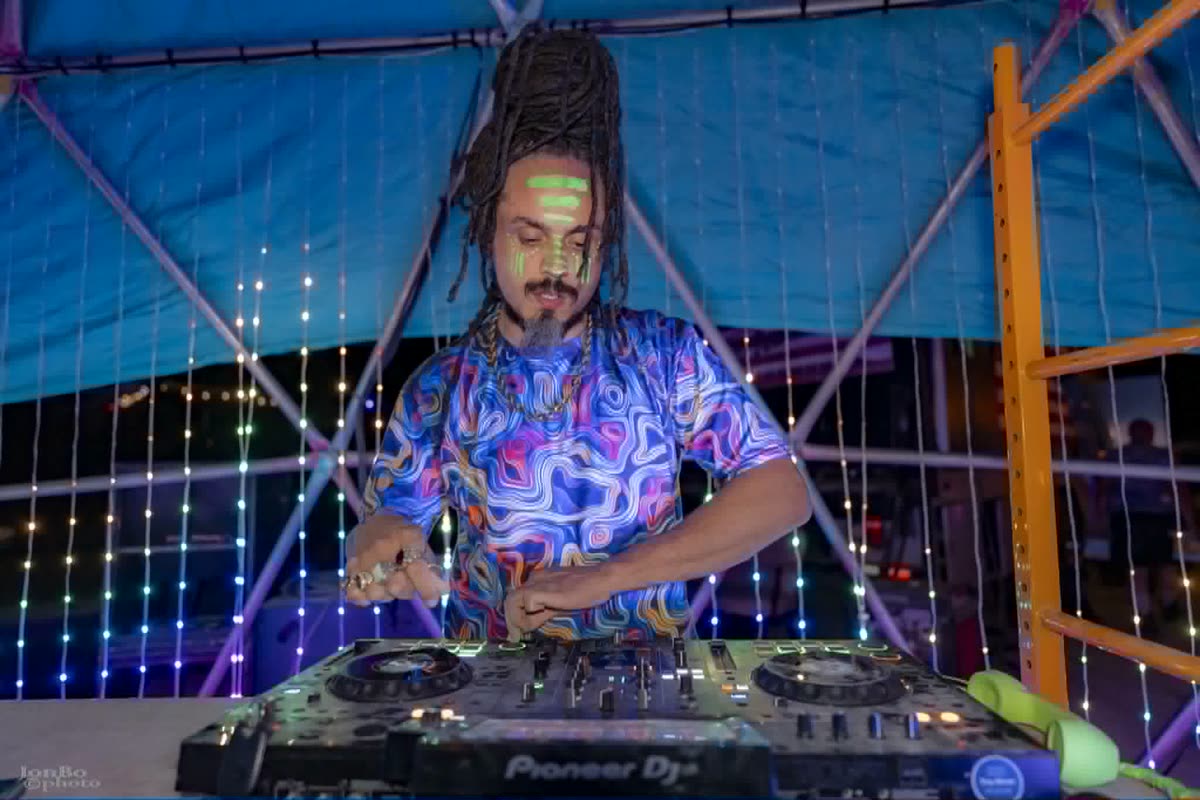
Spaceman is the founder of The Mothership Landing and the face on the markers box. Event producer, DJ, performer, designer, and structural integrator: he works with bodies by day and lights them up by night. Two decades in the transformational music festival and rave scene, in the fields and warehouses these transmissions come from. Always Keep Exploring.